


The Galleries
- Robert E. Petersen Collection
- Ancient Firearms
- The Road to American Liberty
- Seeds of Greatness
- The Prospering New Republic
- A Nation Asunder
- The American West
- Innovation, Oddities and Competition
- Theodore Roosevelt, Elegant Arms
- World War I and Firearms Innovation
- WWII, Korea, Vietnam and Beyond
- For the Fun of It
- Firearms Traditions for Today
- William B. Ruger Special Exhibits
- Freedom's Doorway
Smith & Wesson No. 1 1st Issue revolver w/ Original Gutta Percha Case


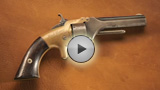 Watch Smith & Wesson First Issue
The gutta percha casing seen here is an original example. Most of these early thermoplastics have not survived; consequently, they are rarely seen today. The S&W No. 1, Ist Issue revolver model inside was manufactured from 1857 to 1860 and about 11,000 were made.
The Smith & Wesson Model No. 1 1st Issue Revolver represents
two significant firsts in the history of firearms - it was the
first in a long line of revolvers produced by the Springfield gun
makers, and it was also the first U.S.-made arm to employ a
self-contained metallic cartridge. The genesis of this new design
was made possible by three factors.
The first was Rollin White's 1855 patent for a cylinder that
featured bored-through chambers. Smith & Wesson obtained
exclusive rights to use this innovation in return for royalty
payments of 25 cents on each revolver produced. One year later,
Samuel Colt's U.S. patents for revolving arms expired, opening the
marketplace to competing designs based on Colt's revolving cylinder
principle. A third key factor in the development of the No. 1
revolver was Daniel Wesson's success in perfecting a self-contained
rimfire cartridge based on the French-designed Flobert round.
Gunsmiths Horace Smith and Daniel Wesson had collaborated on the
development of a lever-action magazine pistol based on the earlier
Jennings repeating rifle design.
This pistol, known as the Volcanic, failed in large part to the
lack of suitable ammunition, but it later became the basis for the
Henry and Winchester repeating rifles. These famous long arms did
yeoman service with U.S. Army troops, settlers, and peace officers
during the Civil War and the Westward Movement. Smith left the
financially-strapped Volcanic Arms Co. in 1855, but Wesson
continued with the struggling firm. During this period, he
continued the duo's earlier work on metallic cartridge design. In
late 1856, the two were re-united and had secured the rights to
White's cylinder patent.
By the following year, Smith & Wesson's revolver factory in
Springfield, Massachusetts was in operation. Initial No. 1
production models featured a square butt with rosewood grip panels;
a silver-plated brass frame with rounded surfaces; and blued
non-fluted cylinder and octagonal barrel. The top barrel flat bore
the stamping, "SMITH & WESSON SPRINGFIELD MASS." Originally
priced at $12.75, the firm later offered an optional gutta percha
case for an additional charge of $1.25. Approximately 5,000 of
these cases, which were produced by Littlefield, Parsons & Co.,
included a bas relief design featuring the revolver and the Smith
& Wesson name on the lid. These cases are rarely encountered
today.
These seven-shot repeaters were chambered for the equivalent of
today's .22 short rimfire cartridge, and although they were lacking
the potency of many of their contemporaries, they represented a
watershed in the development of personal protection arms. Their
metallic cartridges were also far more robust than the skin or
paper varieties commonly used with percussion sidearms. In
addition, they required neither percussion caps nor a powder flask,
thus they could be re-loaded much more quickly than the
larger-caliber competitors marketed by Colt, Remington, and other
firms. Their bottom-break/top hinge tip-up design also added to the
ease with which re-loading could be performed. Empty cartridge
cases could quickly be punched out of the cylinder through the use
of short rod mounted beneath the barrel, and fresh loads were
inserted just as quickly. The use of the small "No.1 Cartridge,"
with its light three-grain charge of black powder, was made
necessary by the tendency of the copper cartridge case heads to
bulge when used with larger calibers or powder charges. This
condition caused the cases to bind against the frame, thus
preventing cylinder rotation.
Aside from the use of a small, low-power cartridge, Smith &
Wesson's design also included a rotating recoil shield that was
fitted to the rear of the cylinder to eliminate this problem.
Unlike other revolver designs of the time, the No. 1 featured a
cylinder stop that was mounted to the top strap and activated when
the two-piece hammer was pulled backward to cock the piece. These
pistols employed no half-cock or other safety mechanism, and their
sheathed spur trigger had no trigger guard. Several modifications
also appeared during the production run of the No. 1 revolver,
including the replacement of the bayonet-type barrel latch common
to the original design with a spring-loaded side projection
button-type catch; inclusion of a non-rotating recoil shield, and a
change from three grove/left-hand twist rifling to five grooves
with a right-hand twist.
More significant alterations were incorporated into the No. 1
Second Issue and No. 1 Third Issue revolvers. In the former, a
larger, irregularly side plate replaced the smaller round plate
common to the First Issue, and the rounded frame was replaced with
a flat-sided design. The Third Issue is easily identified by its
bird's-head butt and fluted cylinder. The No. 1 First Issue was
produced between 1857 and 1860, with a total production of
approximately 11,671 pistols. Introduced in 1860, the No. 1 Second
Issue enjoyed a production run of approximately 117,000 before it
was discontinued in 1868. The No. 1 Third Issue was produced
between 1868 and 1881, with a total production of approximately
131,000 examples. Serial numbers for the First and Second Issue
were sequential, beginning with #1 and continuing through 11,671
for the First Issue, and concluding in the 128,000 range for the
last production Second Issue revolvers. Third Issue serial numbers
range from #1 to 131163.
These revolvers met with widespread popularity, and several
companies on both sides of the Atlantic produced counterfeit
versions of the No. 1, or they introduced their own metallic
cartridge designs in violation of existing patent and license
agreements. American producers, most notably Manhattan Fire Arms
Manufacturing Co., were held by the courts to be guilty of illegal
infringements on Smith & Wesson and Rollin White patents, while
European manufacturers were immune from such lawsuits because U.S.
patents were not recognized overseas at that time.
The original Smith & Wesson versions were in such demand that
by 1863, the company was faced with a one-year backlog in orders.
Some found their way to the fighting fronts during the Civil War,
and noted American humorist Samuel L. Clemens was among those who
purchased these diminutive sidearms. From somewhat humble
beginnings, Smith & Wesson would capitalize on their successes
with the No. 1 series, eventually becoming the dominant
manufacturer of revolvers worldwide.
Although production ceased more than a century ago, interest in
these ground-breaking firearms remains strong among collectors.
Popularity is high in a variety of circles, including collectors of
Civil War and Smith & Wesson arms. Prices for surviving
examples in premium-grade condition far exceed their original 19th
century price tag.